
What Files Are Needed for a CNC Machining Quote? RFQ Checklist for Buyers
Learn what files and details are needed for an accurate CNC machining quote. Practical RFQ checklist for engineers and sourcing teams.
KENDORIC
5/31/20266 min read
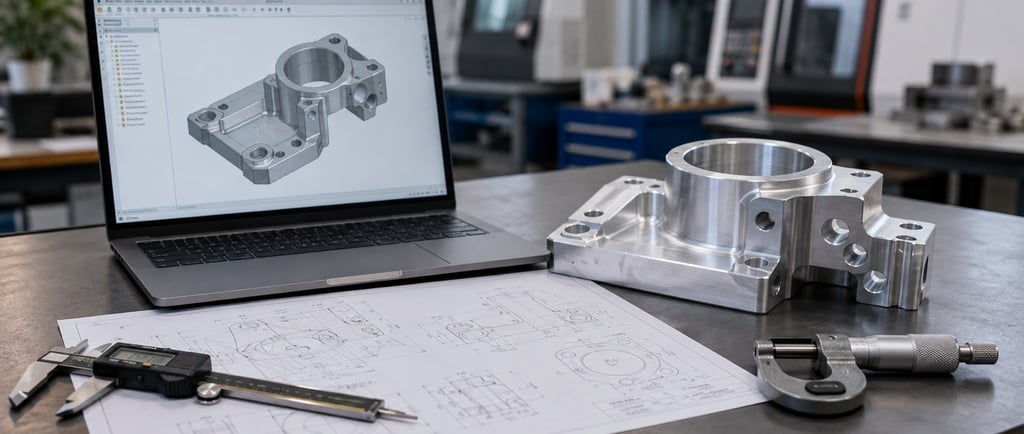
Why Your RFQ Package Determines Quote Quality
An incomplete RFQ is the single most common reason for delayed quotations, inaccurate pricing, and manufacturing misunderstandings. When a supplier receives files without sufficient technical detail, they either make assumptions — and quote incorrectly — or stop to ask questions, which costs everyone time.
Getting a useful CNC machining quote starts before you contact a supplier. It starts when you assemble a complete, unambiguous RFQ package.
Ready to quote now? Send your 2D/3D drawings, material, quantity, surface finish, and inspection requirements to KENDORIC for technical review and quotation.
Request a CNC Machining QuoteUpload Drawings for Review
This guide covers what belongs in that package, what mistakes to avoid, and what to expect from a supplier who reviews drawings before quoting.
1. 3D CAD Files: STEP Is the Standard
The 3D model gives your supplier a clear picture of part geometry, feature complexity, and machining approach. STEP (.step / .stp) is the universally preferred format — it translates cleanly across different CAD and CAM platforms without version conflicts.
Acceptable formats:
FormatExtensionNotes STEP AP214 / AP242.step / .stpRecommended for all submissions IGES.igs / .igesWidely supported; acceptable alternative Parasolid.x_tHigh fidelity; most CAM systems support it Native CAD.sldprt, .catpartUseful if version matches supplier's software
Before sending, verify:
The model is a closed solid — no open surfaces or geometry gaps
Units are set correctly (mm or inches)
No suppressed or provisional features that don't represent the final design
If a 3D model isn't available yet, a well-dimensioned 2D drawing can support an initial estimate — but expect less precision in the quote.
2. 2D Engineering Drawings: Where Tolerances Live
A STEP file shows the shape. A 2D drawing for CNC machining is where you communicate what the part actually needs to perform — tolerances, threads, surface finish, and critical dimensions that must be verified.
Even with a clean 3D model, skipping the 2D drawing is one of the most common causes of quoting errors and post-delivery disputes.
Your 2D drawing should include:
Dimensional tolerances on all critical features. Don't leave everything at general tolerance if dimensions affect fit or function. Common CNC tolerances: ±0.05 mm (standard), ±0.02 mm (precision), ±0.01 mm (high-precision).
Thread specifications: type (M, UNC, UNF, BSPP), size, pitch, depth, tolerance class (e.g., 6H), and whether through or blind.
GD&T callouts for flatness, parallelism, perpendicularity, true position, or runout — with datum references. Informal notes like "keep flat" introduce ambiguity.
Surface finish Ra values on faces with specific requirements (e.g., Ra 0.8 µm for sealing surfaces).
Section views for pockets, internal bores, or cross-holes that standard projections can't fully communicate.
Title block: part number, revision level, units, projection method, and material.
3. Material Grade and Heat Treatment
Specifying "aluminum" or "stainless steel" is not enough. Alloy grade directly affects machinability, material cost, and in some cases, available stock.
Common grades by material family:
Aluminum: 6061-T6 (general use), 7075-T651 (high strength), 5083 (marine / weldability)
Stainless Steel: 304 / 304L (general corrosion resistance), 316 / 316L (food, pharmaceutical, marine), 303 (improved machinability, not weldable), 17-4 PH (high strength, precipitation-hardened)
Steel: 1045, 4140, 4340 (structural); A2, D2, H13 (tooling and fixtures)
Engineering Plastics: Delrin (POM), PEEK, Nylon PA66, PTFE
If heat treatment is required, state it explicitly:
Pre-hardened material condition (e.g., 4140 at 28–32 HRC)
Post-machining treatment (case hardening, nitriding, stress relieving)
Annealing requirements for distortion-sensitive parts
If a material test report (MTR) or mill certificate is required — EN 10204 3.1 is the standard most European buyers specify — include this in the RFQ, not as a follow-up after order placement.
4. Quantity, Batch Size, and Lead Time
Quantity is one of the most significant cost drivers in CNC machining. Setup, fixturing, and programming costs are largely fixed per batch — they spread across however many pieces you order. This is why per-unit cost at 5 pieces looks very different from 200 pieces.
Include:
Prototype quantity (typically 1–5 pcs for first-article validation)
Production quantity per order
Required delivery date or acceptable lead time window
Estimated annual volume, if repeat orders are expected
Stating repeat order potential upfront allows a supplier to amortize tooling and fixturing cost appropriately — and typically results in better unit pricing for production runs.
5. Surface Finish and Post-Processing
Surface treatment requirements affect both part performance and quote accuracy. Some processes require subcontracting to specialist facilities, adding lead time and cost that can only be anticipated if stated at the RFQ stage.
Common post-processing for CNC machined parts:
ProcessTypical Application Anodizing Type IIAluminum — corrosion resistance, cosmetic Hard Anodizing Type IIIAluminum — wear resistance Chromate Conversion (Alodine)Aluminum — conductivity preserved Electroless Nickel PlatingAluminum, steel — uniform coating Black OxideSteel — mild protection, low reflectivity Zinc PlatingSteel — general corrosion protection PassivationStainless steel — removes free iron Bead BlastingAll metals — uniform matte finish Powder CoatingSteel, aluminum — protective/decorative
Specify:
Which surfaces require which finish (referenced to the 2D drawing)
Color for anodizing or powder coating (RAL code or Pantone reference)
Coating thickness where dimensional tolerance is tight (e.g., "anodize 15–25 µm, mask M6 threads")
RoHS compliance if required
6. Inspection Requirements
Inspection requirements vary by application. Stating them in the RFQ allows the supplier to confirm capability and include documentation cost in the quotation.
Common requirements:
First Article Inspection (FAI): Dimensional verification of the initial sample against all drawing requirements. Specify whether a ballooned drawing is required.
CMM Dimensional Report: Full or partial inspection using a Coordinate Measuring Machine. Specify which features or whether 100% of callouts are required.
Material Test Report (MTR) / Mill Certificate: Confirms alloy, heat number, and mechanical / chemical properties.
Hardness Test Report: Relevant for heat-treated parts (Rockwell or Vickers).
Surface Roughness Report: If Ra values on critical faces need documented verification.
RoHS / REACH Declaration: If required for EU market compliance.
7. Common RFQ Mistakes That Delay Quotation
3D model only, no 2D drawing. The STEP file shows shape; the drawing defines what the part must achieve. Without one, the supplier must assume tolerances — often conservatively, which inflates price.
Material listed as a generic category. "Steel" or "aluminum" without an alloy grade is not quotable.
No quantity or delivery date. Without these, a supplier cannot confirm scheduling or apply appropriate batch pricing.
Drawings and models at different revision levels. A mismatch forces a clarification request that can delay the quote by days.
Blanket tight tolerances. Specifying ±0.01 mm on every dimension drives up cost. Reserve tight callouts for features where they are functionally necessary.
Finish and inspection requirements mentioned after order placement. These affect price, subcontracting, and lead time — they belong in the RFQ.
Ready to Submit? Check This First.
Before sending your CNC machining RFQ, run through this checklist.
Have your RFQ package ready? Send drawings, STEP files, material, quantity, finish, and inspection notes for a practical review before quotation.
Submit Your RFQ PackageRequest a CNC Machining Quote
CNC Machining RFQ Checklist
3D CAD Files
STEP file provided for each part (AP214 or AP242 preferred)
Model is a closed solid — no gaps or open surfaces
Units confirmed (mm or inches)
Final design only — no suppressed or provisional features
2D Engineering Drawing
PDF (and native format where available)
Tolerances specified on all critical dimensions
Threads fully defined (type, size, pitch, depth, through/blind, tolerance class)
GD&T controls with datum references
Ra values on surfaces with finish requirements
Section views for internal or complex features
Title block complete: part number, revision, units, projection, material
Material
Full alloy designation (e.g., Aluminum 6061-T6, Stainless 316L)
Heat treatment or material condition stated
MTR / mill certificate requirement specified
Quantity and Schedule
Prototype and/or production quantity defined
Required delivery date or lead time stated
Annual repeat volume noted (if applicable)
Surface Finish and Post-Processing
As-machined Ra values specified where relevant
Post-processing listed with color/specification
Surfaces to mask identified
RoHS / REACH requirements stated
Inspection Documentation
FAI requirement specified
CMM report requirement and scope stated
MTR / material certification requirement confirmed
Additional documentation needs listed (hardness, roughness, RoHS declaration)
Frequently Asked Questions
Q: Do I need both a STEP file and a 2D drawing for a CNC machining quote?
For anything beyond a rough estimate, yes. The STEP file defines geometry; the 2D drawing defines tolerances, threads, finish, and acceptance criteria. Submitting both gives the supplier everything needed to quote accurately and flag any manufacturability concerns upfront.
Q: What if I only have a 2D PDF drawing and no 3D model?
A detailed 2D drawing is often sufficient for an initial quote. The supplier may need to model the part before programming, which can affect lead time. For repeat production parts, a 3D model is a worthwhile investment.
Q: How do I know which tolerances are actually necessary?
A practical approach: apply explicit tolerances only to dimensions that affect assembly fit, sealing, or function. Leave non-critical surfaces at your general tolerance block. If you're unsure, share your design intent with your supplier before finalizing the drawing — most experienced shops can advise on what's functionally necessary and what adds cost without benefit.
Q: Why does quantity affect unit price so much?
CNC machining has significant fixed costs per batch: programming, fixturing, setup, and first-article inspection. These are largely independent of how many pieces you make. As quantity increases, those fixed costs spread across more units — reducing per-piece cost. This is why a prototype run of 3 pieces costs proportionally far more per unit than a batch of 150.
Q: How quickly should I expect a quote response?
With a complete package — 3D file, 2D drawing, material, quantity, finish, and inspection requirements — an engineering-oriented supplier like KENDORIC can typically review the RFQ within 1–3 business days, depending on part complexity. Incomplete submissions that require clarification rounds routinely add several days to that cycle.
Need a drawing review before quoting? KENDORIC can review your RFQ package for machining feasibility, material selection, finish, and inspection requirements.