Files
- 2D drawings
- 3D CAD / STEP files
- Drawing revision if applicable
Engineering-oriented CNC machining support
A practical material selection guide for buyers comparing part function, strength, weight, corrosion exposure, machinability, finishing, tolerance stability, inspection needs, cost, and production quantity.
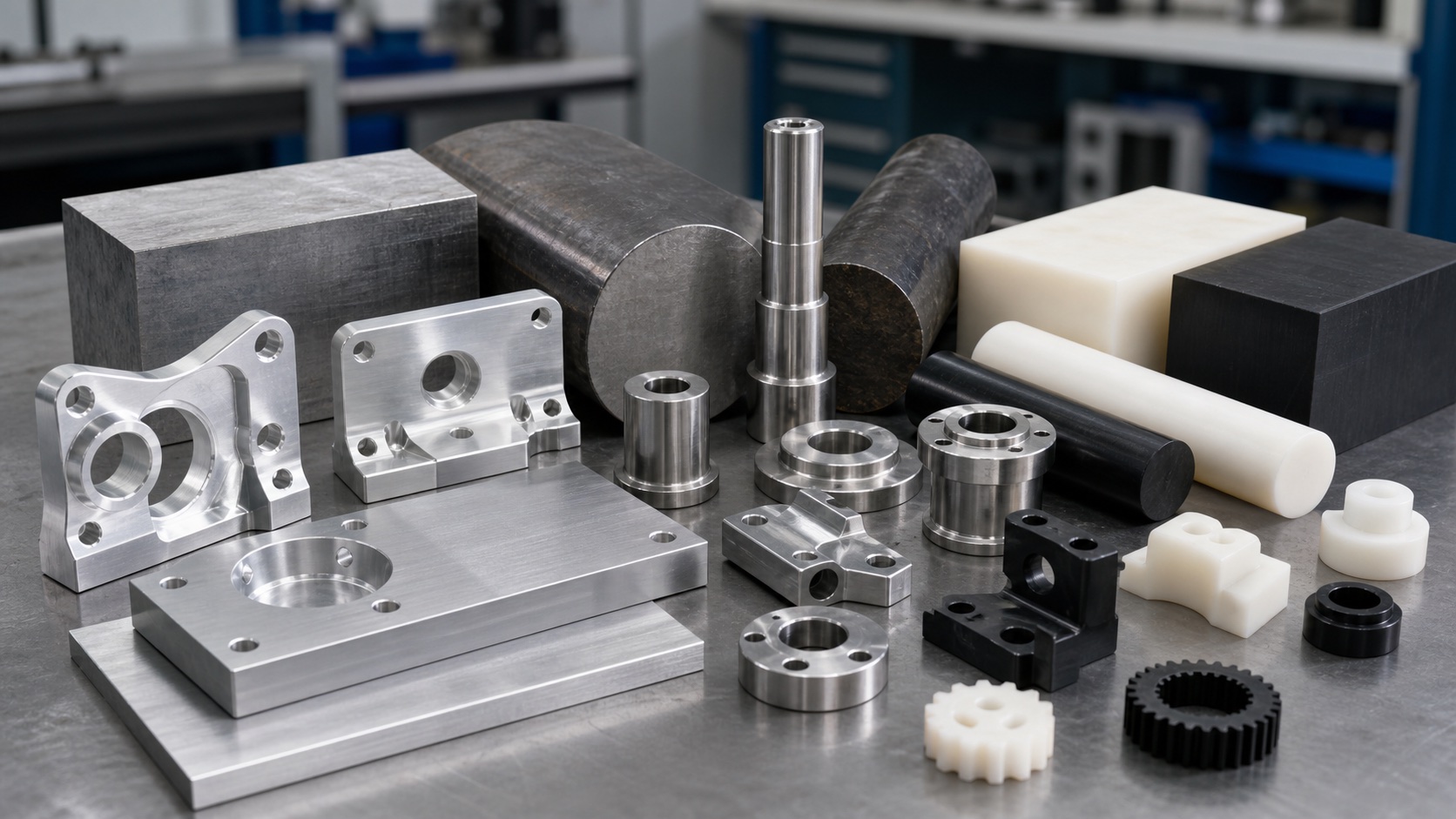
Material selection guide
Choosing a CNC machining material affects machining feasibility, part performance, tolerance stability, finishing options, inspection needs, quotation accuracy, lead time, and cost. A material that works well for a lightweight housing may not be right for a shaft, bushing, fitting, fixture, or high-wear component.
Part requirements
Does the part carry load, support another component, or require thread durability?
Does the design need lightweight aluminum or can heavier steel be accepted?
Will the part face moisture, cleaning, outdoor exposure, chemicals, or high temperature?
Does the part slide, rotate, clamp, seal, locate, or mate with another part?
Will the part be anodized, plated, painted, polished, passivated, marked, or heat treated?
Which features affect assembly, sealing, movement, positioning, or inspection?
Material overview
Material selection should not be based on price alone. Strength, weight, corrosion exposure, finishing compatibility, tolerance stability, and inspection requirements should be reviewed together.
Suitable for lightweight housings, brackets, plates, covers, fixtures, and parts requiring good machinability or anodizing.
Suitable for parts requiring corrosion resistance, strength, wear resistance, clean surfaces, or durable threaded features.
Suitable for stronger mechanical parts, shafts, tooling-related components, or parts requiring heat treatment or surface protection.
Suitable for lightweight, insulating, low-friction, or non-metallic parts, with tolerance and temperature behavior reviewed carefully.
Buyer comparison
| Factor | Why It Matters | Buyer Question |
|---|---|---|
| Strength | Affects load, thread durability, and long-term function | Does the part carry load or support another component? |
| Weight | Affects equipment movement, handling, and assembly | Is a lighter part required for the design? |
| Corrosion exposure | Affects material and finish selection | Will the part face moisture, cleaning, or outdoor exposure? |
| Wear | Affects surface finish, hardness, and material choice | Does the part slide, rotate, clamp, or contact another part? |
| Assembly fit | Affects tolerance and inspection needs | Which features must fit with mating parts? |
Process review
Material choice affects machining time, tool wear, setup strategy, surface finish, and unit price.
Prototype quantity and repeat production quantity may lead to different setup, inspection, and pricing assumptions.
Anodizing, plating, passivation, painting, heat treatment, and marking should be reviewed with the selected material.
Thin plates, deep pockets, stainless shafts, coated bores, and engineering plastics may require tolerance and inspection review.
Material review RFQ
Share your drawings, CAD files, part function, material question, quantity, finish, tolerance requirements, inspection needs, and delivery details for material review before quotation.
Get Material Feedback for Your RFQ